
Unity.
 Unity is a engine that is what some call a portal engine, being used as a transiton from people who use the basic game engines such as Fps creator, into more advanced engines.
Interface: Unity is a basic engine, although in more recent updates the Unity engine has become more Jumbled in my opinion, loosing a lot of its basic layout in a attempt to modernise and try and level with engines such as UDK
Gameplay: Unity gameplay can be modified on the creators preference, and is entirely customisable.

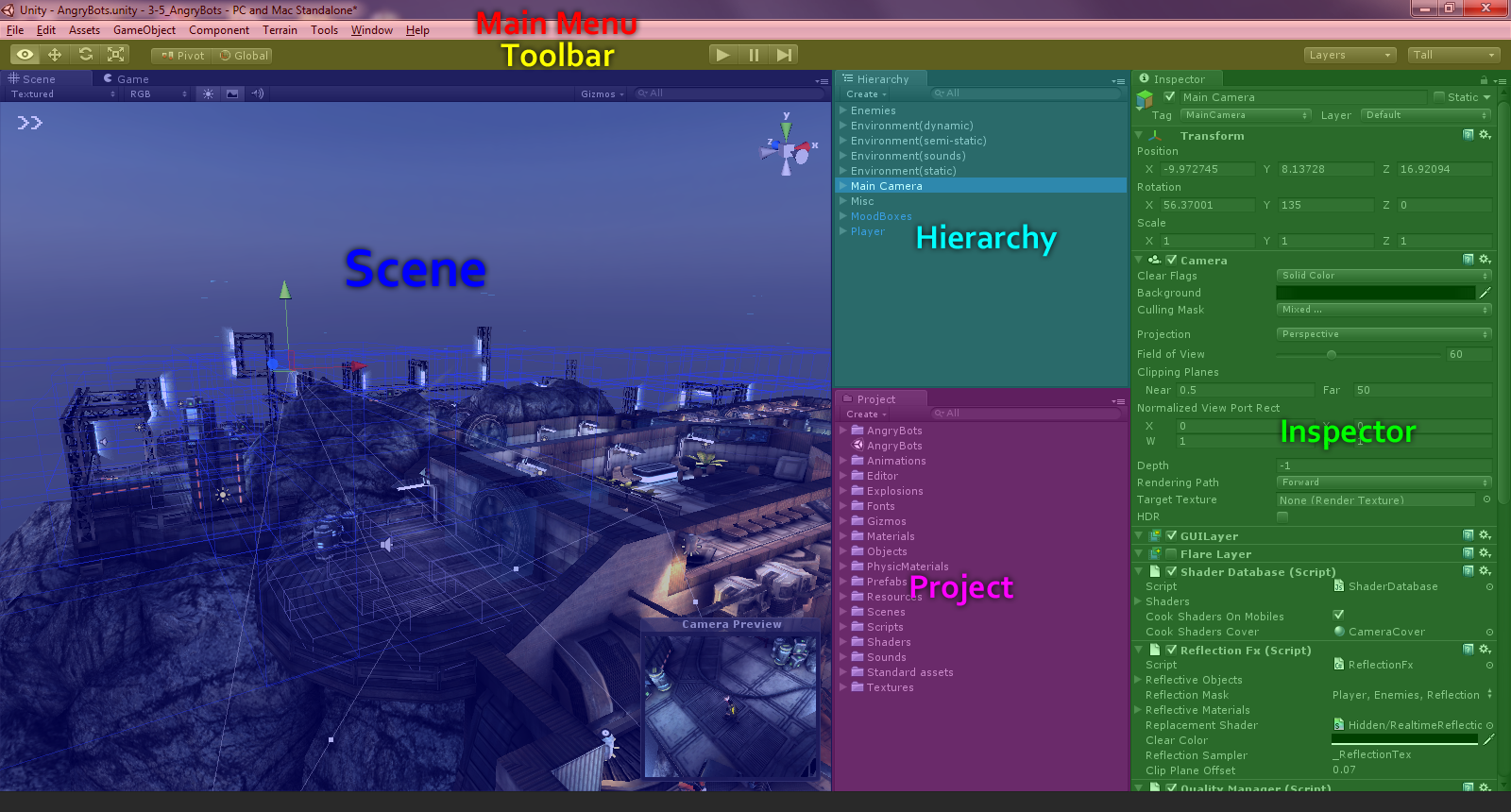
Interface: Unity is a basic engine, although in more recent updates the Unity engine has become more Jumbled in my opinion, loosing a lot of its basic layout in a attempt to modernise and try and level with engines such as UDK
Gameplay: Unity gameplay can be modified on the creators preference, and is entirely customisable.

FPS CREATOR is a engine that originated around 2006, created by TGC (The game creators) The simple interface attracted a lot of the target audience, as it was simpler than many other of the gaming engines at the time.

Interface
From personal experience the FPS Creator interface is generally easy to get the hang off, the level design interface is easy to understand and use, mostly consisting of a point click type of interface, for general, one of the most intresting things about the simple interface, it is easier is it's use of universial symbols for sav which makes it easier for a user coming over to FPSC
Gameplay: FPSC game play is smooth and generally runs at 60fps. however it lacks the options to be able to change the graphical options, despite the lack of options, FPSCs gameplay isn't that bad, although there are bugs such as prop jumping, although sometimes it uses way more CPU than it should.
Rendering: FPSC rendering is generally okay for the time period it was created, it is simple, although for a decent quality lightmap the user has to make modifications to the games files, otherwise all the player can use for rendering is a crappy shading attempt,
Ray Game Designer
Ray Game Designer is a less known engine, mainly used on the older systems, the engine was made in 1997, and last updated in 2000, before it was followed up by the more up to date version RGD2.
Interface
The interface came with several programmes, used for Creating levels, texture and enemies.
 The Texture editor was simple, you clicked on one of the empty boxes, and imported a texture that was a PCX file (the game engine relied on PCX files heavily at the time, and many people had trouble since before 2006 PCX files were hard to get access to, so many people relied on a programme called Ifranview, if they couldn't afford other programmes.)
 The mobile editor allowed you to import sprites, and then using the sliders, able to control the mobiles speed, height, health etc aswell as sounds.


Ray Game Designer is a less known engine, mainly used on the older systems, the engine was made in 1997, and last updated in 2000, before it was followed up by the more up to date version RGD2.
Interface
The interface came with several programmes, used for Creating levels, texture and enemies.


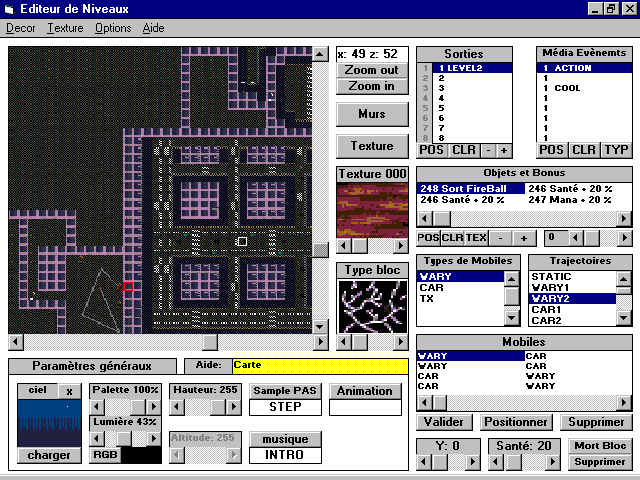
The Level editor was really basic, and you were able to essentially paint levels, however due to the engines technology, you either had a sky or a roof, and you couldn't make transitions from outdoors to indoors in one level, the Tree looking block controlled if the block was solid, water or harmful, and you had to import mobiles from your files, aswell as choosing certain objects to make guns etc, a lot of the objects such as Items and guns were created In-Game, which made organising the game a lot easier (In my opinion)

Gameplay
The gameplay resembles something from the typical game of 1994, such as Doom, the gameplay was simple, and was very bug free, however if you were using a system such as XP, you would have to "Trick" the game engine into thinking it was running on a windows 98 or 95 version of windows, otherwise the game engine would not run, despite that is suppose to be compatible with windows XP, More advanced systems such as Vista or windows 7 can run the engine easily if given the right conditions.
For 2d

RPG Maker XP
Rpg maker XP is the next in line after RPG Maker 2000, It is a very popular game engine, and it's popularity has led to it being used in many Indie games, freeware and not, the engine is known for it's easy to use interface, despite appearing quite complex, many users of RPG maker XP will find that they are easily able to create a RPG game within a few clicks, the game uses a very simple coding system, with a more advance version for those who wish to script their own scripts from scratch.
Interface.
What sets RPG maker XP apart from the rest is the basic layout, and easy to understand layout
Tyron: Progammers

RPG Maker XP
Rpg maker XP is the next in line after RPG Maker 2000, It is a very popular game engine, and it's popularity has led to it being used in many Indie games, freeware and not, the engine is known for it's easy to use interface, despite appearing quite complex, many users of RPG maker XP will find that they are easily able to create a RPG game within a few clicks, the game uses a very simple coding system, with a more advance version for those who wish to script their own scripts from scratch.
Interface.
What sets RPG maker XP apart from the rest is the basic layout, and easy to understand layout
3D
Gathering the team
Notes
Plot of the game
Roles of the team
If you a smaller role, may need to pick up other roles
Choosing the right people for the right tasks
-Know each others capabilities
Be honest with the game and the people
- Honesty is the best policy
Make sure you are all on board
Focus
Good communication within the team
Don’t be precious about your ideas
Accept criticism gracefully
Prepare for ideas to be shelved or changed
Deadline
Work schedule
Individual roles
Damon: Programmer
Tyron: Progammers
Kyle: 3d Modeling/animation
Matt: 3d Modeling/animation
Draven: Environment Design
Responsibilities
I am responsible for the creating the game environements for the level, and importing 3d models and so fourth into the game environemtn.
How are you going to document the development process?
The process will be documented via Screenshots and Video.
How are you going to show evidence of testing and refining your game development outcomes as individuals in a team and the team as a whole?
The way for my to test, is to allow people to look at the environment, and give comments on the environment, which I will take notes off, and if possible, record it, from there I will document the development of what I will be adding to the environment
Psudocode
Psudocode is a way of coding, where you write down the area of codes in normal writing, like a simple step by step instructional, and you use these as comments, so the programme does not use these for the code, then you write the code underneath these comments, a example of this would be opening a door, which is actually a Job that is required for my Roll in the team as a level designer.
The door has 2 segments, a Model and a trigger.
The steps will be:
Of course you can add or remove the trigger, using the door entity as a trigger itself, since such a system is easier in unity.
My 2d Game will be made with RPG Maker VX Ace.
My game idea is to be set in a unknown location, based on Japan. The player starts off as a samurai, who is almost killed in a Duel, that occurs at random, the Player then decides that they want to join one of the 3 dojos in his Town, the 3 are Onoha Itto, Tennen Rishin, and Yushin, all 3 of the schools have their own techniques, however you can only train one school the entire game, so the player has to choose wisely, the player can also have Bouts with other swordsman, there is a choice between using real swords and wooden swords, with wooden swords the Player can attack other swordsman and not kill them, therfore the swordsmen will go on and spread word about the players skills, or in the Unoffical tournaments, use real blades, and the player will recieve a negative reputation, which will spread bad things about them, and yet have their fame grow in the underground.
The Fame works as follows.
Good Fame.
Pros.
Invited to Shoguns tournament.
Respected by all
Discount in stores.
Special Items.
Special Jobs.
Discount on swords.
Cons.
Occasional Criminals and swordsman will try and kill you to get fame.
Can be Assassinated.
Netural
Pros: Not attacked randomly bar at night.
Netural.
Can be left alone.
Not widely known.
Cons: Not widely known.
No Discount.
No special items.
Negative fame.
Discount through Fear, Slightly more than good fame.
Feared
Special Items
Special Jobs
Invited to partake in various Underground Sword duels and Jobs.
Cons
Wanted by Shinsengumi. (Elite Sword unit for the Shogun)
Wanted by Bounty Hunters.
Random Samurai will attack you.
Kicked out of Dojos.
Can be Assassinated.
The game will also come to feature a realistic Damage system, which is based on the Results of a moderate sword Cutting into a rolled up magazine with a wooden dowel in the centre (tougher than a actual arm)
The Injury system will go into grades, I will use the Wrist for example:
Left Wrist
Grade 0: Fine
Grade 1: Minor Injury.
Grade 2: Deep Injury, Minor Bleeding, Minor Pain
Grade 3: Bone Deep Injury, Moderate bleeding, Pain depends on characters Level. Loss of agility and speed.
Grade 4: Bone Cut through, Major bleeding, Speed Down, Agility down, Player is Defeated. Major Pain
Grade 5: Arm has been severed, the Player is basically unable to use their sword. Major Pain.
This system is yet to be implimented in game, at the moment the player has 2 Injury States, Which is bleeding and Broken Bones.
The player can also get wanted by partaking in Unoffical tournments or Not reporting a Attack to the Majistrates office within 24 hours of the event, there are 3 levels, one is that they will just take you for questioning, so you will basically just spawn outside the Majistrates office, Second is they will disable you then take you to questioning, Third is that they will basically Kill you on sight.
The game uses a TOD system, the game's lighting will change depending on the time of day.
The game uses RPG Maker VXAce's code system, Below are a few examples.


Psudocode
Psudocode is a way of coding, where you write down the area of codes in normal writing, like a simple step by step instructional, and you use these as comments, so the programme does not use these for the code, then you write the code underneath these comments, a example of this would be opening a door, which is actually a Job that is required for my Roll in the team as a level designer.
The door has 2 segments, a Model and a trigger.
The steps will be:
1)
Is player In proximity of
trigger
2)
Door Moves to “Open Position”
3)
Is player still in trigger
zone?
4)
Move to “Close position”
5)
Reset to step 1.
My 2d Game will be made with RPG Maker VX Ace.
My game idea is to be set in a unknown location, based on Japan. The player starts off as a samurai, who is almost killed in a Duel, that occurs at random, the Player then decides that they want to join one of the 3 dojos in his Town, the 3 are Onoha Itto, Tennen Rishin, and Yushin, all 3 of the schools have their own techniques, however you can only train one school the entire game, so the player has to choose wisely, the player can also have Bouts with other swordsman, there is a choice between using real swords and wooden swords, with wooden swords the Player can attack other swordsman and not kill them, therfore the swordsmen will go on and spread word about the players skills, or in the Unoffical tournaments, use real blades, and the player will recieve a negative reputation, which will spread bad things about them, and yet have their fame grow in the underground.
The Fame works as follows.
Good Fame.
Pros.
Invited to Shoguns tournament.
Respected by all
Discount in stores.
Special Items.
Special Jobs.
Discount on swords.
Cons.
Occasional Criminals and swordsman will try and kill you to get fame.
Can be Assassinated.
Netural
Pros: Not attacked randomly bar at night.
Netural.
Can be left alone.
Not widely known.
Cons: Not widely known.
No Discount.
No special items.
Negative fame.
Discount through Fear, Slightly more than good fame.
Feared
Special Items
Special Jobs
Invited to partake in various Underground Sword duels and Jobs.
Cons
Wanted by Shinsengumi. (Elite Sword unit for the Shogun)
Wanted by Bounty Hunters.
Random Samurai will attack you.
Kicked out of Dojos.
Can be Assassinated.
The game will also come to feature a realistic Damage system, which is based on the Results of a moderate sword Cutting into a rolled up magazine with a wooden dowel in the centre (tougher than a actual arm)
The Injury system will go into grades, I will use the Wrist for example:
Left Wrist
Grade 0: Fine
Grade 1: Minor Injury.
Grade 2: Deep Injury, Minor Bleeding, Minor Pain
Grade 3: Bone Deep Injury, Moderate bleeding, Pain depends on characters Level. Loss of agility and speed.
Grade 4: Bone Cut through, Major bleeding, Speed Down, Agility down, Player is Defeated. Major Pain
Grade 5: Arm has been severed, the Player is basically unable to use their sword. Major Pain.
This system is yet to be implimented in game, at the moment the player has 2 Injury States, Which is bleeding and Broken Bones.
The player can also get wanted by partaking in Unoffical tournments or Not reporting a Attack to the Majistrates office within 24 hours of the event, there are 3 levels, one is that they will just take you for questioning, so you will basically just spawn outside the Majistrates office, Second is they will disable you then take you to questioning, Third is that they will basically Kill you on sight.
The game uses a TOD system, the game's lighting will change depending on the time of day.
The game uses RPG Maker VXAce's code system, Below are a few examples.
Below that is some video and Screenshots of the game.

No comments:
Post a Comment